Image is copyrighted and may not be copied or used without permission.
More information about this image:
| PhotoID | D300CRW01466 |
| Location: | Portland, Oregon |
| High Resolution File Size: | 2160x1440 pixels, 300DPI up to 7.20" x 4.80" |
| Largest Print Size: | Great Prints up to 16"x24" in size (larger may still be acceptable in some cases) |
Detailed Description - Click Here
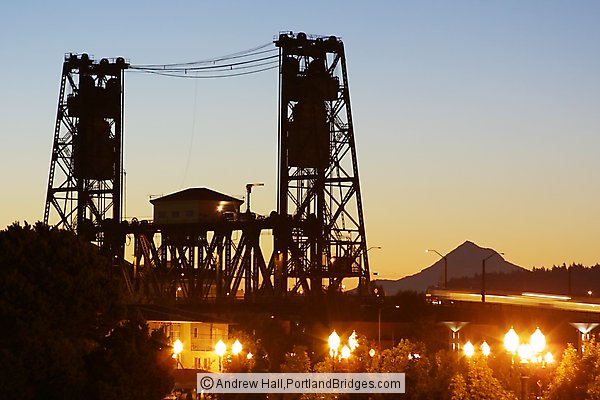
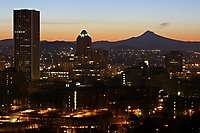
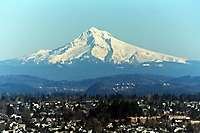
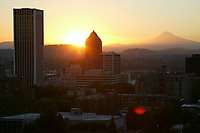
Mt. Hood: Mt. Hood, in the Cascade Mountain range, was named after British Admiral Samuel Hood in 1792. Aside from being a popular skiing destination an hour from Portland and an eye-catching backdrop in the Portland skyline, Mt. Hood is in fact an active volcano, as all of the major peaks of the Cascades are. Of course, Hood's sister to the north, Mt. St. Helens, had its most recent major eruption in 1980. Geologists monitor all the cascades including Mt. Hood for volcanic activity. Someday, maybe not in our lifetimes, Mt. Hood will erupt again, but who knows when?
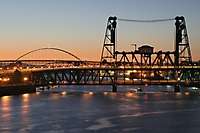
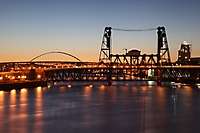
Steel Bridge: This is the bridge the Amtrak trains cross when leaving Portland to
the south or east. Portland's MAX light rail train crosses on the top
deck, also. Cars use it, too!
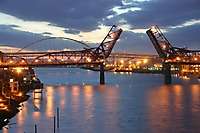
Finished in 1912, the Steel Bridge is considered
unique because it is one of the only known dual-lift bridges in the world.
That is, the lower deck (Amtrak and freight trains) can be lifted independently
of the upper deck (MAX, automobiles) to allow some clearance.
The current Steel bridge replaced an earlier on at approximately the
same spot that was built in 1888. [1]
References:
[1] Smith, Dwight. Historic Highway Bridges of Oregon. Second
Edition. Portland, Oregon: Oregon Historical Society, 1989. P. 208.